Romance tropes
Every trope is a promise your reader has already accepted. The work is paying it. Below are a hundred and twenty, with what each one owes and where it usually goes unpaid.

What is a romance trope?
A trope is a pattern your reader already knows. Enemies to lovers, forced proximity, the marriage of convenience, the second chance: each names a shape a story can take, and a romance reader recognises the shape long before the first chapter ends. Book tropes work the same way in every genre. Romance is where they get named out loud.
That recognition is the transaction. Someone who picks up an enemies-to-lovers book has already agreed to the ending. She knows these two finish together. What she is paying for is the route.
And the route has to cost somebody something. Enemies to lovers promises that the hostility is real, that it has a cause, and that putting it down will take something off one of them they wanted to keep. Forced proximity promises they cannot leave. A second chance promises the first failure still stings and that neither of them gets to be entirely the injured party.
Break the promise and your reader notices at once, even when she cannot say what went wrong, and what comes back instead is that the book felt flat or that the romance was unearned. She means the label was on the cover and the pressure stayed off the page.
Which is why the usual complaint lands wrong. Charles Baxter, writing about repetition in fiction, put the pleasure somewhere other than surprise, in the way a choice lands hardest when the reader sees late that it was right all along.
A cliche is a different animal, and the difference sits in the record rather than the pattern: a cliche is a trope whose promise went unpaid so often that readers stopped expecting anyone to pay it. The archetypes page takes the neighbouring question of what separates a type from a stereotype.
The twelve that carry most of the genre
Readers name these first and blurbs lead with them. Each entry gives the promise, the scene that pays it, and the way it most often goes unpaid.
Enemies to lovers
The dislike has to be real and putting it down has to cost, which you pay in the scene where one of them defends the other and gains nothing at all by doing it. Austen built Pride and Prejudice on the version where both parties were partly right, so the reversal costs an apology on each side.
Friends to lovers
Speaking risks something that already works. The debt comes due when the friendship is visibly damaged and going back stops being available. Emma turns on it: Knightley is the person Emma tells everything to, right up until he becomes the one thing she cannot discuss with him.
Slow burn
Every delay needs a cause outside the writer, and your reader should be able to name it in one sentence. The failure is a book where the only thing between them is the chapters remaining. Readers catch that fast, because the pair keep having conversations that one more honest line would end, and neither of them has a reason to hold that line back.
Forced proximity
Leaving is not available. Prove it by writing the scene where one of them tries to go and cannot. A storm, a contract, a shared assignment, a house with one warm room: the mechanism matters less than whether the attempt to escape happens on the page. Skip it and the confinement reads as staging.
Only one bed
Closeness arrives before either of them agreed to it. The morning settles it, not the night, because that is when the two of them have to decide what the night meant. Written as a joke it costs nothing. Written as an accident with consequences, it moves them a stage on without either one choosing to.
Fake relationship
The performance starts running on something real and the two of them notice at different times, so pay it in the moment one keeps performing after the audience has left the room. The common failure is forgetting to put an audience in the book at all.
Second chance
The first ending still hurts and both of them own a piece of it. Watch for the old argument restarting almost word for word. Persuasion is the model. Anne and Wentworth parted for reasons that were defensible at the time, which is what makes eight years of silence readable rather than stubborn.
Grumpy and sunshine
The guard went up for a reason and warmth alone will not bring it down, so what settles it is the sunny one being hurt by the grump and staying anyway. A grump who is charming by page ten is a mild person with a reputation.
Marriage of convenience
A contract forces intimacy neither of them chose, so the contract has to be expensive to break. Make the exit cheap and the marriage becomes a flat-share. Charlotte Lucas is the cold version in Pride and Prejudice: she marries Collins for a house and security, states her reasons plainly, and Austen lets the bargain stand.
Secret identity
The truth will cost the relationship when it lands. Everything depends on the scene after the reveal, where the wronged one has to decide and the deception counts as a real injury. Forgive it inside a page and the secret was decoration for the two hundred pages it occupied.
Age gap
Two life stages want different things on different timelines. The gap earns its place when it produces a specific disagreement, about children, money, or how much time is left. A number with no consequence attached is a detail. A mismatch in what each of them is planning for is a plot.
Forbidden love
A rule exists and somebody has the power to enforce it. Payment is enforcement arriving. The Age of Innocence keeps the rule unspoken and total. Newland and Ellen hear no explicit prohibition, and the society around them closes the exit anyway. A rule that goes unpoliced is a preference.
A hundred and twenty romance tropes
These are romance novel tropes grouped by what puts the two of them under pressure: pairs who start opposed, pairs who start close, the ones forced together, the ones with something hidden, the ones bound by an arrangement, second chances, the ones crossing a line somebody enforces, and the ones the setting creates. Each line says what the situation is and what it costs them.
- Enemies to lovers
- They start as real opponents, and every step toward each other costs one of them ground
- Rivals to lovers
- Both want the same prize, so wanting each other means one of them gives it up
- Grumpy and sunshine
- One is guarded for a reason and the other is not, and warmth alone will not open the door
- Opposites attract
- Each wants the thing the other has spent a life refusing to give anybody
- Hate at first sight
- The first judgement was fair on the evidence, so changing it means finding evidence neither went looking for
- Lovers to enemies to lovers
- Trust is given, broken on purpose, then asked for again by the person who broke it
- Friends to lovers
- The friendship works, and saying anything puts the version that works out of reach
- Best friend's sibling
- Wanting this person spends credit with a third who was not asked and has a say
- Childhood sweethearts
- They already know the worst of each other, and the old version still has a claim
- Unrequited to requited
- One has wanted this for years in silence, so the yes arrives owing an apology
- Slow burn
- Something specific keeps them apart in every chapter, and your reader can name it each time
- Forced proximity
- Circumstance locks them into the same space and takes away the option of walking out
- Only one bed
- A logistics problem puts them close before either decided to be, and the morning has to account for it
- Snowed in
- Weather suspends the outside world, and whatever they avoid indoors has nowhere else to go
- Fake relationship
- They agree to perform a couple for an audience, and the performance outlasts its reason
- Roommates
- Shared daily life shows each of them what dating would have let the other hide
- Road trip
- Confinement and motion together, so the conversation they have been avoiding has hours to arrive
- Secret identity
- One of them is not who the other thinks, and the truth is expensive whenever it lands
- Amnesia
- A missing past means the person in front of them wants different things than the one they loved
- Mistaken identity
- A wrong assumption goes uncorrected, and every day of not correcting it raises the price
- Secret baby
- A decision was made alone years ago and now has to be explained to the person it concerned
- Hidden wealth
- One is rich and hiding it, so being loved unrecognised is the thing under test
- Marriage of convenience
- A contract puts them in a marriage neither wanted, and breaking it costs more than staying
- Arranged marriage
- Family or duty picks the match, and what either of them wants arrives second
- Marriage pact
- A promise made lightly years ago comes due, and one of them means to hold the other to it
- Second chance
- They loved each other once and it ended for reasons that were sound at the time
- Reunited after years
- Both changed enough that the person they are meeting is not the one they remember
- Divorced and back
- They already tried marriage and it failed, so the case for trying again has to be made
- Forbidden love
- A rule stands between them and somebody with power is prepared to enforce it
- Boss and employee
- One signs the other's cheques, so consent and career are tangled in the same conversation
- Age gap
- Different life stages want different things, and the timelines only look compatible from close up
- Bodyguard
- One is paid to keep the other alive, so wanting them compromises the job that protects them
- Bickering partners
- They argue by habit, and neither notices it is the only sustained attention either gets
- Feuding families
- Their households have a quarrel older than both of them, so choosing each other picks a side
- Business rivals
- Their companies want the same contract, so every honest conversation is also a leak
- Opposing counsel
- They are paid to defeat each other, and doing the job well makes the rest worse
- Cop and criminal
- One enforces the law the other breaks, so affection asks somebody to stop doing their job
- Enemy commanders
- They lead opposing sides, and a private truce would betray the people who follow them
- Reformed rake
- He has a record and she knows it, so every decent act reads as a longer con
- Ice queen thaws
- She is composed by design, and warmth costs her the standing the composure bought
- Beauty and the beast
- One is feared or disfigured, and being seen properly is the thing that has been withheld
- Redemption arc
- One of them has real harm to answer for, and being loved is not the payment
- Brother's best friend
- Wanting him means going behind a brother who trusts him and would object out loud
- Girl next door
- Proximity made them familiar, so the shift has to overcome years of being unremarkable
- Friends with benefits
- They agreed feelings were excluded, and the agreement is the first thing to break
- Pen pals
- They know each other's minds before their faces, so meeting risks what the letters built
- Long distance
- Distance keeps it theoretical, and closing the gap tests whether either wants the daily version
- Mutual pining
- Both want it, both are certain the other does not, and the silence compounds monthly
- One-sided crush
- Only one of them is in this, and the other's ordinary kindness keeps the hope alive
- Rekindled friendship
- They lost touch for a reason, and picking it up means handling the reason
- Coworkers to lovers
- They meet daily in a professional register, and changing it puts the register at risk
- Stranded
- Transport fails somewhere remote, and the two of them are the only resource available
- Quarantine
- An outside rule confines them together for a fixed period that neither can shorten
- Undercover as a couple
- The job requires the performance, and the job punishes anyone who breaks character
- Trapped in a lift
- A fault removes the exit for an hour, and the conversation has nowhere else to go
- Shared custody of a pet
- An animal neither will surrender forces a schedule of regular contact
- Neighbours
- A shared wall makes every private version of themselves audible to the other
- Team assignment
- Work pairs them and rates the output, so failing to cooperate is expensive for both
- Hostage situation
- Danger strips out the small talk and leaves whatever each of them says under pressure
- Marooned
- Rescue is not coming soon, and surviving means trusting the person they least wanted to
- Snowstorm shift
- A closure keeps the staff on site overnight, and the building has one warm room
- Secret relationship
- They are together and cannot say so, and the concealment costs them both allies
- Undercover agent
- One is lying about why they are here, and the assignment ends when the lie does
- Catfish
- One knows the other only through a false account they built and cannot now retract
- Twin swap
- A substitution starts as a favour and becomes a deception with a person's feelings in it
- Hidden illness
- One conceals a diagnosis, and the concealment is how they keep being treated normally
- Secret nobility
- A title is being hidden, so affection given now cannot be checked for motive later
- Ghostwriter
- One writes the words the other is praised for, and credit is the unspoken debt
- Fake name
- The name is invented, and everything built on it comes down when somebody checks
- Witness protection
- A past that cannot be discussed turns every ordinary question into a risk
- Anonymous benefactor
- One has been helping unseen, and revealing it converts gratitude into obligation
- Letters under another name
- Correspondence built the intimacy, and the wrong person is collecting the credit
- Green card marriage
- Immigration status depends on the marriage holding, and an inspection can end it
- Contract relationship
- Terms were written down, and the terms stop matching what either of them wants
- Mail-order bride
- They committed before meeting, and the arrangement holds while they find out who arrived
- Political alliance
- Two houses need the union, and personal preference has no standing in the negotiation
- Betrothed since childhood
- The match was made for them years ago, and refusing it costs a family something
- Inheritance clause
- A will requires the marriage, so the estate and the feeling cannot be separated
- Fake engagement
- A ring was produced to solve a problem, and the problem outlasts the intention
- Debt marriage
- A family debt is settled by the match, and gratitude makes a poor foundation
- Bought bride
- Money changed hands for the match, so being wanted for herself becomes the question
- Left at the altar
- One walked out in public, and the other decides whether an explanation is owed
- Returning home
- Coming back means meeting the version of themselves the town has kept on file
- Widow or widower
- A previous love is not finished, so the new one makes room rather than replaces
- Missing presumed dead
- One returns after being mourned, and the life built in their absence has claims
- Break up and make up
- They already know how this ends badly, so doing it again needs new evidence
- Estranged spouses
- The marriage exists on paper, and repairing it is harder work than leaving
- Old flame at a wedding
- A shared occasion puts them together in front of an audience that remembers
- Letters found late
- Something written years ago surfaces and changes what the separation actually meant
- Do-over
- A second attempt is granted, and the original mistake is still available to repeat
- Teacher and student
- An authority relationship makes consent structurally complicated whatever both of them feel
- Doctor and patient
- Professional duty forbids it, and the duty exists because the imbalance is real
- Best friend's ex
- Loyalty and wanting point opposite ways, and somebody outside the pair gets hurt
- Priest or nun
- A vow stands in the way, and breaking it costs a whole life rather than a rule
- Married to someone else
- A prior commitment exists, and any honest route through it damages a third person
- Class divide
- Money and manners separate them, and the world enforces the gap without being asked
- Cross-cultural
- Two sets of expectations collide, and one of them gives ground where others can see
- Royal and commoner
- Protocol forbids the match, and the institution has the means to prevent it
- Enemy nations
- Their countries are at war, so being together is a crime in at least one place
- Mentor and protege
- One shaped the other, so the influence has to be unpicked before consent is clean
- Sibling's ex
- Family loyalty turns the match into a standing offence at every gathering
- Small town
- The whole street is watching, so a private decision becomes public inside a day
- Holiday romance
- A fixed end date was agreed in advance, and one of them stops agreeing to it
- Workplace romance
- Careers and feelings share a building, and one of the two will have to move
- Grand gesture
- A public act settles it, and the size of the gesture has to match the harm done
- Third act break up
- A late separation tests whether the change in them was real or only situational
- Love triangle
- A third person is genuinely viable, so choosing means losing something real
- Meet cute
- The first meeting is chance and charming, and the charm has to survive a second look
- Meet ugly
- The first meeting goes badly, and correcting the impression is the story
- Marriage in trouble
- The relationship already exists and is failing, so repair is the plot rather than courtship
- Single parent
- A child's interests come first, and the romance has to be worth the disruption
- Nanny or housekeeper
- Employment puts one inside the other's home life with no standing to be there
- Sports romance
- A season sets the calendar, and the career decides where either of them lives
- Rock star and civilian
- Fame makes privacy impossible, and one of them signed up for that and one did not
- Billionaire
- Extreme money removes the ordinary obstacles, so the remaining ones have to be human
- Fated mates
- Something outside them declares the match, so choosing it freely becomes the problem
- Soulmates
- They are told they belong together, which removes the decision unless the story restores it
- Bet or dare
- The relationship starts as a wager, and discovery of the wager is guaranteed
- Makeover
- One is remade to be acceptable, and being loved as the original is the unfinished business
- Marriage of inconvenience
- They are already married and cannot stand it, so the plot is repair rather than pursuit
The names move around, so treat this as the working set rather than a closed list. Most romance novels run two or three of these at once, and which ones you pair matters more than any single choice.
Three promises, paid and refused
The same mechanism in three novels you can read for nothing. One promise paid late and in full, one made out loud so the cost is on the record, and one left unsaid until it is too late to matter.
1Second chance, paid at full price
Wentworth writes to Anne after eight years of saying nothing, and prices the silence in the same breath.
The number is the payment. Austen could have written a reunion and let the years stay vague, and instead she puts eight and a half of them in the sentence where he asks. Notice also who is charged. He says she almost broke it, which grants that the original refusal was hers, and he asks anyway. A second chance that costs one of them nothing is the version readers call unearned.
Try this. Find the sentence in your draft where the two of them agree to try again. If the years between are not named or felt in it, the reader is being told about a debt rather than watching it settled.
You pierce my soul. I am half agony, half hope.I offer myself to you again with a heart even more your own than when you almost broke it, eight years and a half ago.
2The gap said out loud
Jane names the exact terms of the imbalance she is standing in, to the man who holds the better end of it.
Four adjectives, and every one of them is a fact about her position rather than her feelings. This is what a class-divide or employer trope owes and usually skips. The rule between them gets stated by the person it costs, in front of the person it favours, and neither can pretend afterwards that it was not raised. Bronte makes Jane do the naming, which is why the scene holds.
Try this. Give the person with less power one speech where they say the imbalance plainly. If your draft has nowhere to put it, the gap is decoration.
Do you think, because I am poor, obscure, plain, and little, I am soulless and heartless?
3The promise refused
Selden reaches Lily's room the morning after she dies, and the novel closes on the thing neither of them said in time.
Every trope on this page can be run this way, and it is the strongest proof that the promise is real. Wharton sets up a marriage plot across four hundred pages and then declines to pay it, and the ending lands because the reader had been promised something specific and can feel the exact shape of what was withheld. A book that pays nothing and promised nothing is not sad. It is empty.
Try this. If you mean to break the promise, make it louder first. A refusal only hurts in proportion to how clearly the reader was told what to expect.
in the silence there passed between them the word which made all clear
Do romance tropes only work one at a time?
Rarely on their own. Open any blurb and count: enemies to lovers, forced proximity, only one bed. Three promises in one line, and the line is doing the work a pitch does.
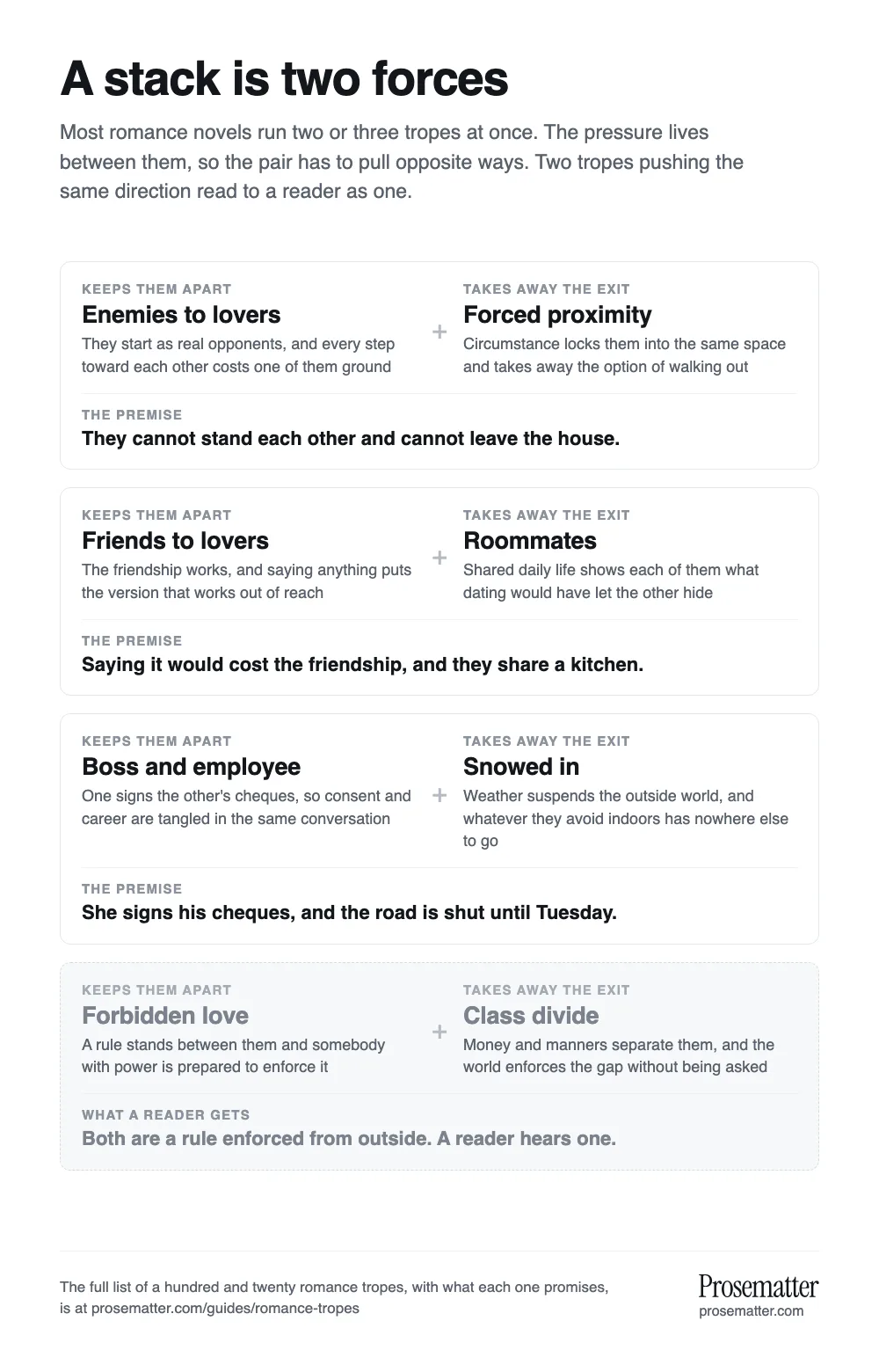
Stacking solves a problem a single trope cannot. One promise rarely supplies enough pressure to fill eighty thousand words, because once the pair are speaking honestly there is nothing left to spend. Two tropes pulling in different directions keep the pressure up: the enmity says stay apart, the snowstorm says you cannot, and every scene has to be written between those two instructions rather than around them.
The pairing is also the commercial decision, which is why it is worth making on purpose rather than discovering in the third draft. A stack is what a comparison title is made of, what a retailer keyword string carries, and what a reader is scanning for when she picks one book over another with the same cover. Choose the two that contradict each other. Two tropes saying the same thing, forbidden love plus a class divide, read to a reader as one.
What the stack cannot do is pay itself. Each promise in the line still owes its own scene, so a book carrying three of them owes three, and the most common failure on a stacked premise is a book that collects the labels and settles one. Work out who these two are to each other first: the relationship chart is where the obligations get written down, and the arc is what changes once they are paid.
The same scene with an editor on it
An unpaid promise is hard to see in your own draft, because you already know what the scene is supposed to mean. Here is an enemies-to-lovers turn with the enmity missing. The note is from Elena Cruz, a line editor inside Prosematter.
Drag to compare original and revised text


Questions & Answers
- What is a trope in a book?
- A trope is a story pattern readers recognise, like enemies to lovers or a marriage of convenience. It is a shape, not a fault. Romance leans on tropes more openly than most genres, because the ending is already settled and the pattern is the thing a reader chooses between when she picks one book off the shelf instead of another.
- What is the difference between a trope and a cliche?
- A trope is a pattern. A cliche is a trope whose promise went unpaid so often that readers stopped expecting anyone to pay it, which is a fact about the record rather than about the shape. Same words on the cover. The difference shows up in whether the setup costs anybody anything.
- What is the most loved romance trope?
- Enemies to lovers is the one readers name most, with friends to lovers, forced proximity and grumpy-sunshine close behind. Popularity is a weak reason to choose. A better test is which pressure you can keep running for eighty thousand words without the two of them sitting down and sorting it out.
- What are some cliche romance tropes?
- The tired ones are the ones written without their cost. A misunderstanding that one conversation would end. A love triangle where one option was decoration. Instant hatred that turns out to be a bad first day. Each is in the table above with the place it goes wrong.
- What are some forbidden romance tropes?
- Forbidden romance covers anything with a rule and someone to enforce it: boss and employee, bodyguard and client, feuding families, a line drawn by a profession. The trope works when the rule has teeth. If breaking it costs them nothing, your reader is being told a secret rather than shown a risk.
- Do romance tropes only show up one at a time?
- Most romance novels stack two or three. Enemies to lovers plus forced proximity plus only one bed is a common run, and the stack is usually what the blurb describes. Stacking fixes a pacing problem too, because one trope on its own rarely supplies enough pressure to carry a whole book.
Work out who these two are to each other
A trope stack is a relationship under pressure, and the relationship chart is where you lay out who owes what to whom before the pressure starts.
Open the character relationship chartOpen a chapter. Everything it needs is already beside it.
The cast, the places, the rules you invented, the note you left yourself last November. Nothing to hunt for, nothing to keep in sync by hand — and with the friction gone, the days you write start adding up.